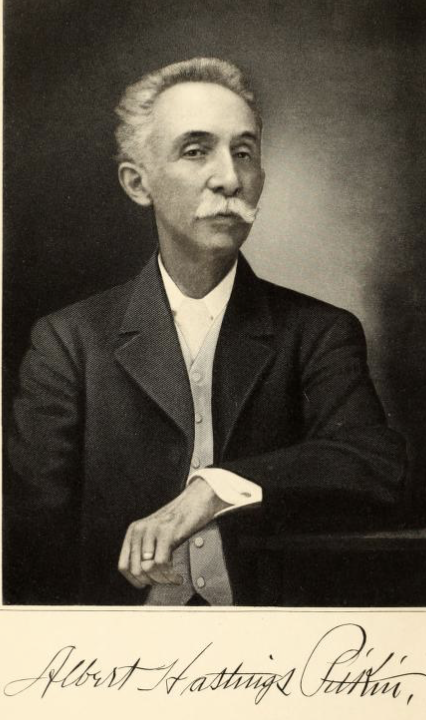
 Albert Hastings Pitkin (August 20, 1852 – October 14, 1917) was a prominent American art curator, antiquarian, and pioneer in the systematic study and collection of early
American pottery.
Albert Hastings Pitkin (August 20, 1852 – October 14, 1917) was a prominent American art curator, antiquarian, and pioneer in the systematic study and collection of early
American pottery.Queer Places:
Cedar Hill Cemetery, 453 Fairfield Ave, Hartford, CT 06114, United States
Albert Hastings Pitkin (August 20, 1852 – October 14, 1917) was a prominent American art curator, antiquarian, and pioneer in the systematic study and collection of early
American pottery.
Born in Hartford, Connecticut, Pitkin was the eldest child of Albert Palmer Pitkin and Jane Ann Hastings. He was a direct descendant of William Pitkin, one of the original settlers of East Hartford.
Outside of his passion for decorative arts, Pitkin worked in insurance in Hartford, partnering with Alfred T. Richards at the Connecticut Mutual Life Insurance Company.
He was married to Sarah Howard Loomis Pitkin (1853–1921), who actively supported his research and travels across North America and Europe.
In the spring of 1884, while visiting a farmhouse in Connecticut, Pitkin discovered two pieces of redware (lead-glazed earthenware). This sparked a lifelong passion for American ceramics.
Pitkin built an extensive collection and became recognized as one of America's leading experts on New England redware and Bennington pottery.
In 1910, he became the Curator of Ceramics at the Wadsworth Atheneum in Hartford, overseeing the installation of his collection at the museum’s Morgan Memorial.
Following his death in 1917, his wife donated over 300 historic objects to the Wadsworth Atheneum and published his definitive research manuscript, Early American Folk Pottery, Including the History of the Bennington Pottery (1918).
In 1910, Pitkin was elected to the Horace Walpole Society, an exclusive organization established by prominent scholars, collectors, and antiquarians to study American decorative arts, architecture, and historical preservation.
Upon his death in November 1917, the Walpole Society adopted formal resolutions praising his "companionable qualities," deep knowledge of ceramic art, and readiness to assist fellow scholars.
While Pitkin was married to Sarah Howard Loomis, his legacy intersects with LGBTQ+ social history through several key historical contexts:
The society is named after Horace Walpole, the English art collector and writer whose bachelor lifestyle, aestheticism, and letters have made him a central figure in queer and LGBTQ+ art history.
The Walpole Society and late 19th/early 20th-century decorative art circles are widely documented in LGBTQ+ historical databases (such as queerplaces). These antiquarian groups provided significant community and professional support for bachelor collectors, queer connoisseurs, and aesthetic scholars of the Gilded and Progressive Eras.
Historical documentation of Pitkin and his fellow Walpoleans is archived in decorative arts repositories—such as the Winterthur Museum, Garden & Library—frequently cited in queer historical studies exploring 20th-century American art collecting circles.
References:
Support this project
This website is a passion project researched, developed, and funded entirely by me. If you find the content valuable and would like to help support the ongoing research and hosting costs, any contribution is deeply appreciated.
Thank you for keeping this independent resource alive!
My books on Amazon: Elisa Rolle's books